Applied AI · Flagship case study
Turning sensitive inputs into structured AI reflection reports
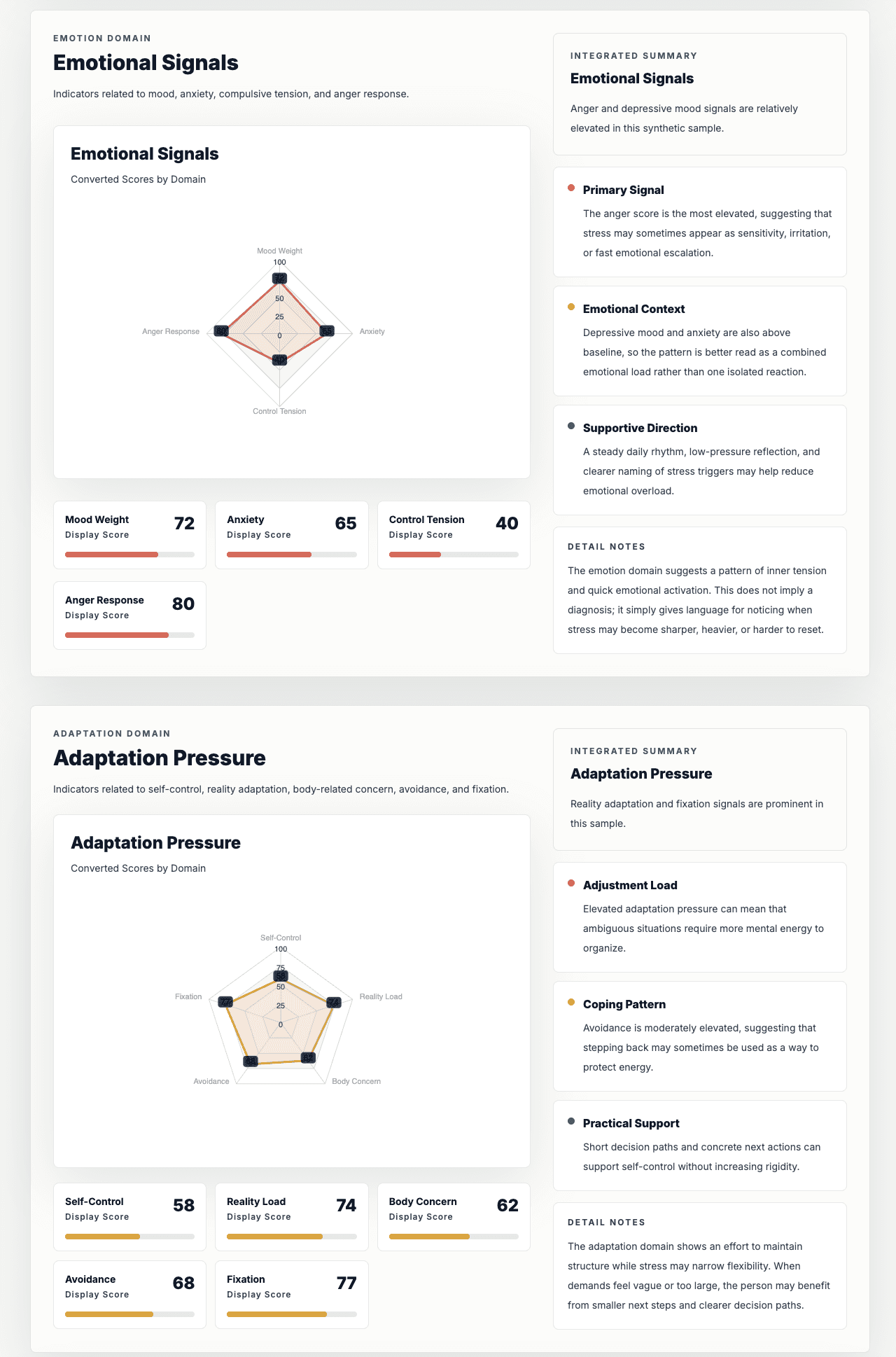
I rebuilt a legacy HTP reporting flow as a modern full-stack product, connecting a typed report contract, review surfaces, and non-diagnostic language rules instead of relying on unconstrained prose generation.
- Role
- Product design · Full-stack engineering · AI integration
- Period
- May 2026 — Present
- Disclosure
- Public portfolio version · Core generation logic redacted
3,000+
Reports generated
80%+
Favorable feedback
Typed JSON
Report contract
Problem and constraints
- The legacy report flow separated presentation from data in ways that made a consistent premium experience difficult to extend.
- Sensitive psychology content needs more than fluent language. It needs non-diagnostic wording, bounded claims, and a review path.
- The production scoring and generation rules are proprietary, so the public portfolio must show the architecture without exposing private logic or user data.
Product flow
- 01
Input and identity
Member and admin routes carry image and text inputs through authenticated flows.
- 02
Structured generation
A private pipeline applies analysis plus safety and tone rules to report JSON.
- 03
Contract validation
A typed PremiumNarrativeReport shape bounds variation from free-form output.
- 04
Rendering and QA
Angular report components and admin surfaces expose results, history, and presentation for review.
Key engineering decisions
Structured contract over free-form prose
Sections, charts, and prompts are modeled in JSON so the UI and generation pipeline have a stable boundary.
Separate basic and AI reports
The premium narrative was added as an independent renderer and data flow without breaking the existing report experience.
Treat admin QA as product work
The system includes payload and history review instead of stopping at a generate button.
Non-diagnostic language rules
Wording avoids clinical diagnosis and deterministic identity claims, focusing instead on possibilities and reflection.
Reviewable evidence
- The public repository exposes the Angular report renderer, authentication flow, admin API clients, and typed models.
- API contracts, public architecture, tone and safety rules, and redaction boundaries are documented.
- Production records show 3,000+ reports generated and more than 80% favorable collected feedback.
Safety and disclosure boundaries
- — The product is for reflection and demonstration, not medical diagnosis or treatment.
- — The public repository excludes user data, private scoring, prompts, interpretation logic, and runtime secrets.
- — Feedback figures summarize product records and do not represent clinical efficacy.
Stack
- Angular 20
- RxJS
- Node.js
- Express
- TypeScript
- MySQL
- OpenAI Responses API