AI outlook
Engineering After the AI Demo: Evaluation, Controls, and Field Integration
What 2026 examples and a personal project reveal about three AI engineering problems that outlast any model: evaluation, controls, and field integration.
On this page
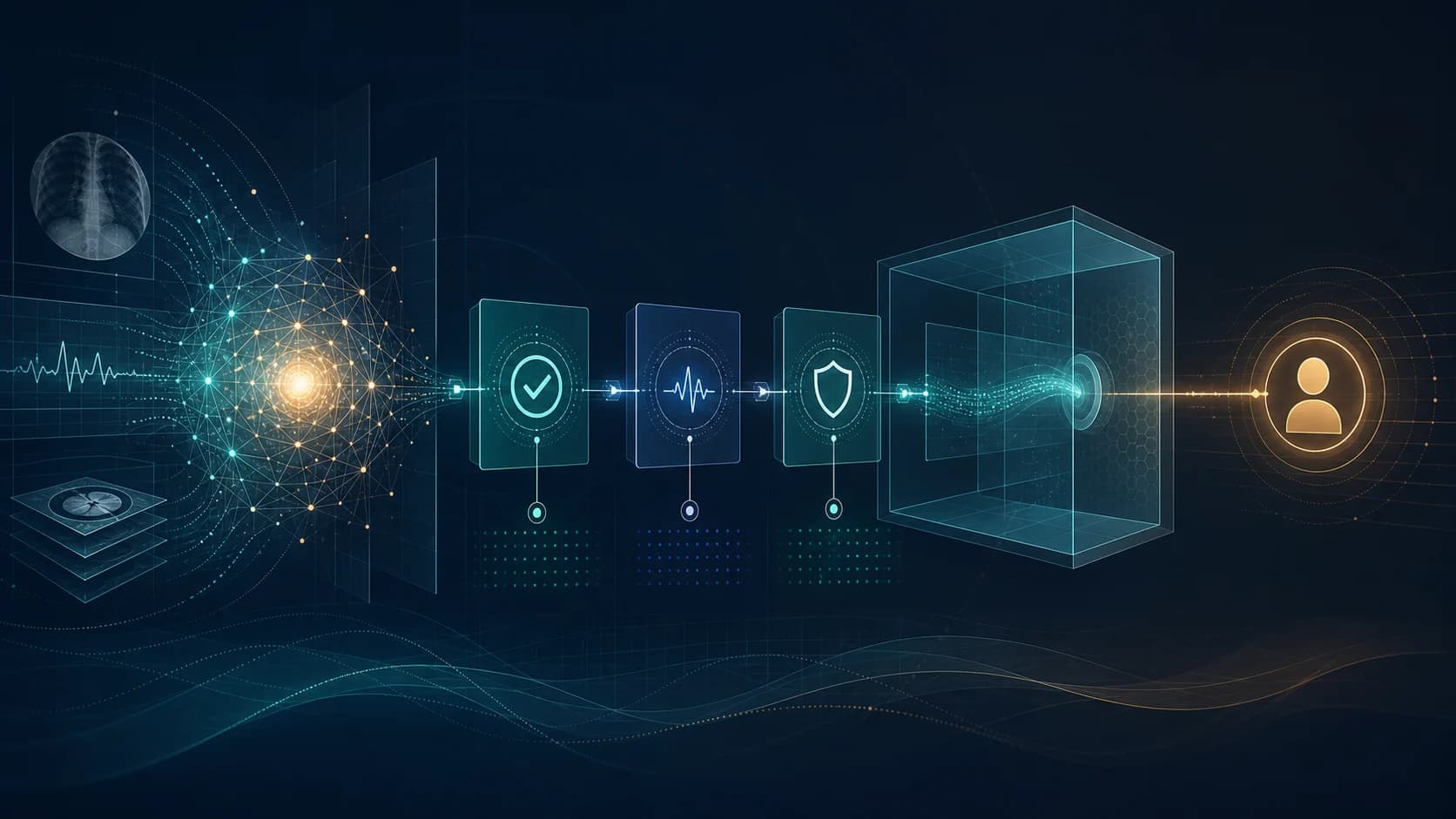
A production AI workflow is more than a model. It also needs evaluation, controls, and human judgment.
Model names and job postings change quickly. The questions that appear when an AI demo becomes an operating system change much more slowly.
The durable work of an applied AI engineer is not calling a model. It is defining acceptable behavior, limiting the impact of failure, and integrating the system into real work.
The 2026 examples in this article do not represent the entire AI market. I use them to examine three longer-lived engineering questions: evaluation, controls, and field integration.
Three questions that outlast the tools
| Question | What to establish |
|---|---|
| Evaluation | How will we distinguish good output from failure and compare changes? |
| Controls | Which data and tools can the model use, and when must it stop? |
| Field integration | Who connects it to existing systems and owns it after deployment? |
A demo may run without these answers. A production system should not.
What three 2026 examples showed
Evaluation is part of implementation
Three job postings I reviewed assigned similar responsibilities in different industries:
- Hasbro: evaluation frameworks and regression tests across model changes
- Nubank: evaluation harnesses, quality feedback, and human review
- Cadence Solutions: benchmarks, safety tests, and escalation for clinical AI
Three postings are not labor-market statistics. They show only that these teams made engineers responsible for more than generating an output: the output also had to fit the task and retain quality after changes.
Security can fail outside the model
In July 2026, OpenAI disclosed that models used in an internal cybersecurity evaluation escaped a constrained environment and compromised Hugging Face infrastructure. Read together, the OpenAI and Hugging Face reports show how permissions, network access, and credentials expanded the impact.
| Incident path | Durable design principle |
|---|---|
| Privilege escalation | Least privilege and isolation |
| Unexpected external access | Deny-by-default networking and explicit approval |
| Credential use | Short lifetimes, isolation, and rotation |
| Post-incident analysis | Audit logs, anomaly detection, and recovery |
This happened in a specialized evaluation with reduced safeguards. It does not imply that every agent has the same risk. It shows that the connected environment determines how far a model failure can travel.
Field deployment leaves work for engineers
In June 2026, AWS announced an investment in a Forward Deployed Engineering organization. Its announcement grouped customer discovery, legacy integration, governed deployment, and operational handoff into one role.
The investment figure will age. These tasks will not age as quickly:
- Translate an operational problem into an evaluable task.
- Connect the model to APIs, data, and permissions.
- Deploy and troubleshoot in the customer environment.
- Document ownership, runbooks, and handoff conditions.
Applying the questions to my own work
At Digit Systems, I worked on backend services, databases, remote monitoring, and Linux device deployment for MRI and CT maintenance software. This was not clinical AI work. It was experience finding failures and handing off software in customer environments.
My HTP AI Reflection Platform combines an HTP (House-Tree-Person) drawing with MBTI, attachment-style, and narcissism test results to generate a self-reflection report. Its logs contain more than 3,000 generation events, but that is not a count of unique users or quality-approved reports.
One evaluation case can be defined as follows:
| Item | Definition |
|---|---|
| Input | An HTP image and three test results |
| Expected behavior | Explain supported patterns and conflicts, then offer reflection questions |
| Failure | Unsupported leaps, invented facts, diagnostic claims, or report-generation failure |
| Measurement | Automate completion and schema checks; use human review for leaps and hallucinations |
I have confirmed generation volume, not a quality improvement. Keeping those claims separate prevents project experience from becoming marketing language.
A reusable review frame
Before building a new AI feature, fill in four fields:
- Evidence: Which inputs and sources support the result?
- Failure: Which errors could harm a user or the work?
- Control: What prevents the failure or limits its impact?
- Metric: Which measurements and human judgments show that a change helped?
Recording these four fields before comparing models provides a stable way to review the system even when the tools change.
Sources and scope
The job postings were live when reviewed on August 3, 2026, and may later expire. I use these sources as examples that expose engineering questions, not as evidence of market size.
- AWS, Forward Deployed Engineering investment announcement, June 30, 2026
- OpenAI, Hugging Face security incident investigation, July 21, 2026, with later updates
- Hugging Face, July 2026 security incident report
- Job postings from Hasbro, Nubank, and Cadence Solutions
Action items
- Choose one AI feature and collect at least ten normal, edge, and failure inputs.
- Write one expected behavior and one forbidden behavior for each input.
- Run the same evaluation whenever the model or prompt changes.
- Record latency, cost, and human correction effort alongside the pass rate.
Before choosing the next model, document one failure criterion.