Production systems · Operations case
Making field-device delivery repeatable and observable
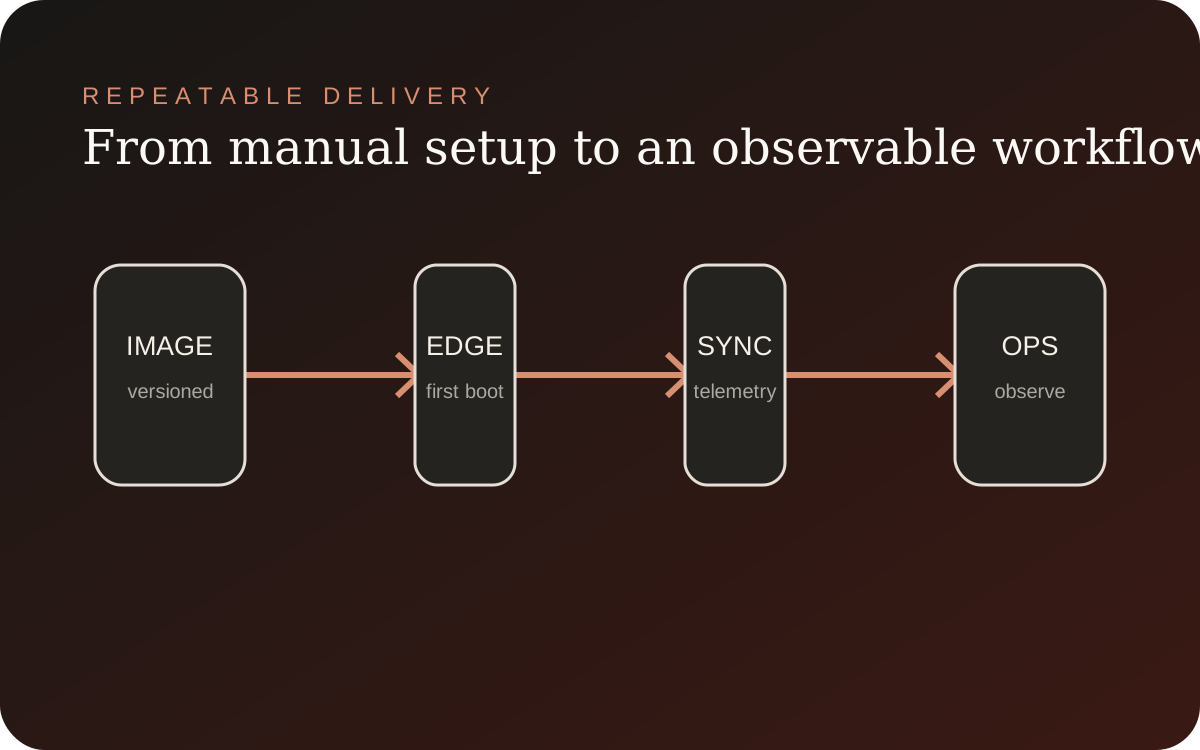
I replaced manual Raspberry Pi and Linux setup with an operating flow connecting versioned images, first-boot automation, remote visibility, and end-to-end validation. Customer identity and proprietary implementation details are intentionally omitted.
- Role
- Backend · Deployment automation · Operational quality
- Period
- Jan. 2026 — Present
- Disclosure
- Employment case summary · Implementation private
30+
Devices using automation
100+
Monitored installations
200+
Playwright E2E tests
Problem and constraints
- Manual device setup created missed steps and environment drift while making remote diagnosis difficult.
- Field hardware cannot be replaced or accessed like a typical web instance, so first boot and recovery paths must be predictable.
- The work supports medical-imaging operations, which means customer, network, and deployment details cannot be shared publicly.
Operating flow
- 01
Versioned image
A common base environment reduces device-by-device drift.
- 02
First-boot automation
Python and Linux services execute installation and configuration in a repeatable order.
- 03
Remote visibility
Node.js, Python, and WebSocket flows expose device and connection status.
- 04
Regression validation
Playwright E2E tests exercise operational web flows and important failure scenarios.
Key engineering decisions
Turn instructions into executable procedure
Scripts and service dependencies enforce the sequence instead of relying on operator memory.
Record state, not just success
Step-level status and logs help narrow failures when a field installation cannot be accessed directly.
Include the operations UI in test scope
E2E coverage validates user-facing workflows as well as deployment automation.
Keep security claims tied to a threat model
Device identifiers alone are not described as strong secrets; automation and key management remain separate problems.
Reviewable outcomes
- Operational records show the automated setup flow applied across more than 30 devices.
- The remote monitoring work supports and validates more than 100 installation environments.
- More than 200 Playwright tests found real application defects and continue to protect key workflows.
Disclosure boundaries
- — Customer names, network topology, device identifiers, secrets, and production screens are not disclosed.
- — Figures summarize work I performed and do not describe the scale of the employer’s full system.
- — This page is a case summary focused on operational reasoning and problem solving.
Stack
- Python
- Linux
- Raspberry Pi
- Node.js
- WebSocket
- MySQL
- Playwright